FLX-300
Best suited for
- Gaskets
- Soft robotics
- Dampers
- Custom-fit parts
From €65.00

Frequently asked questions
The elastomer resin for parts that return to shape
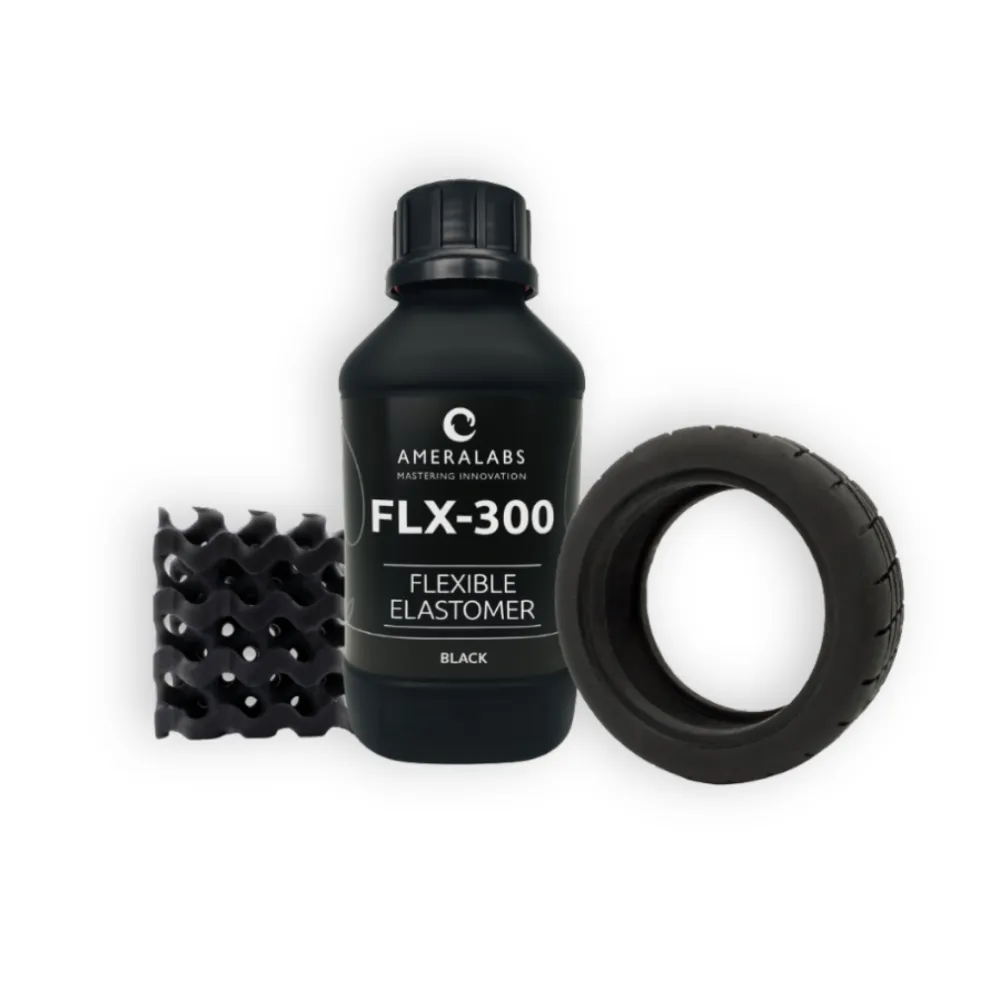
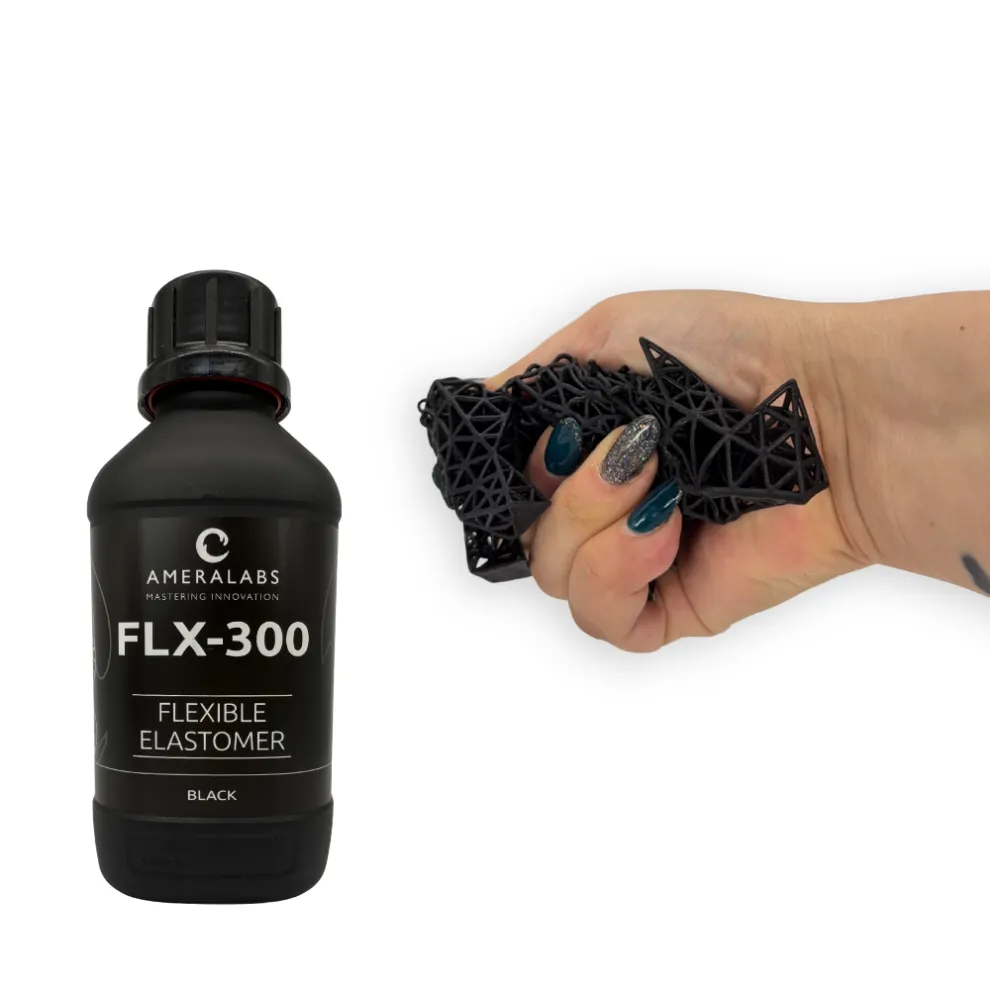
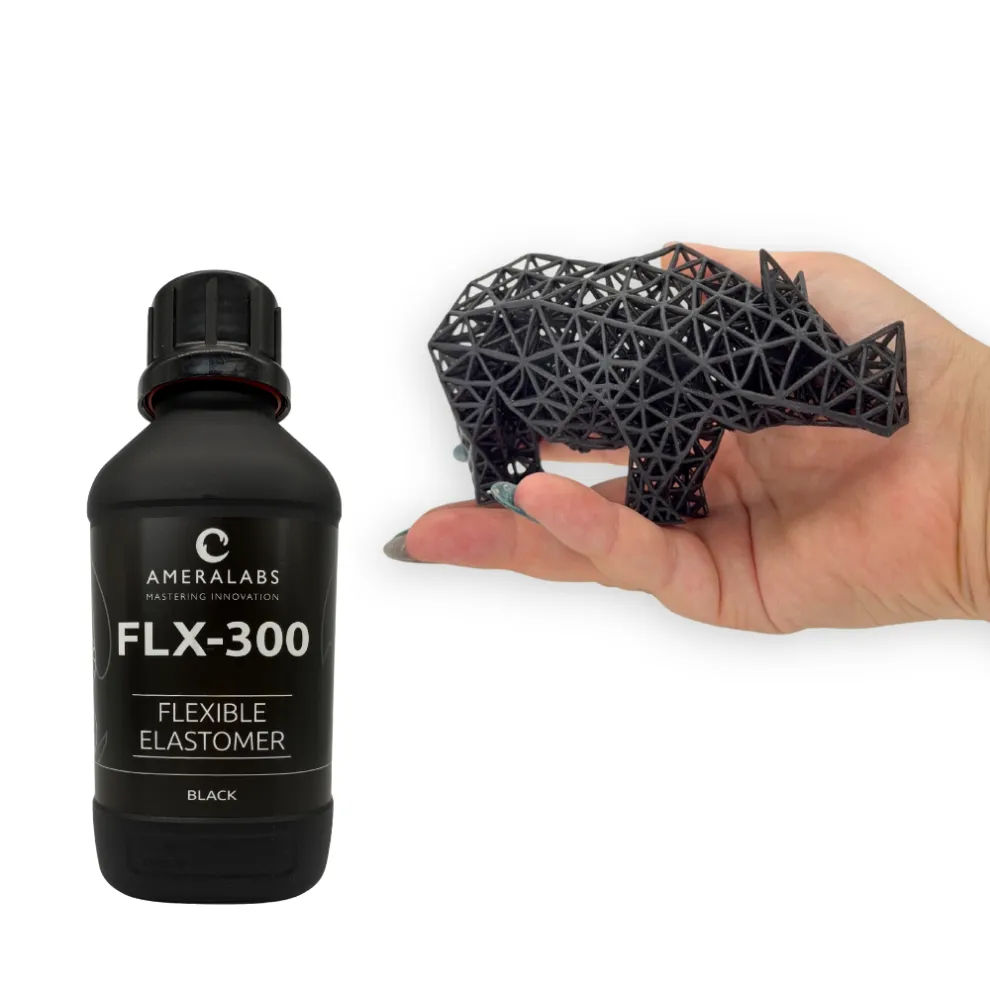
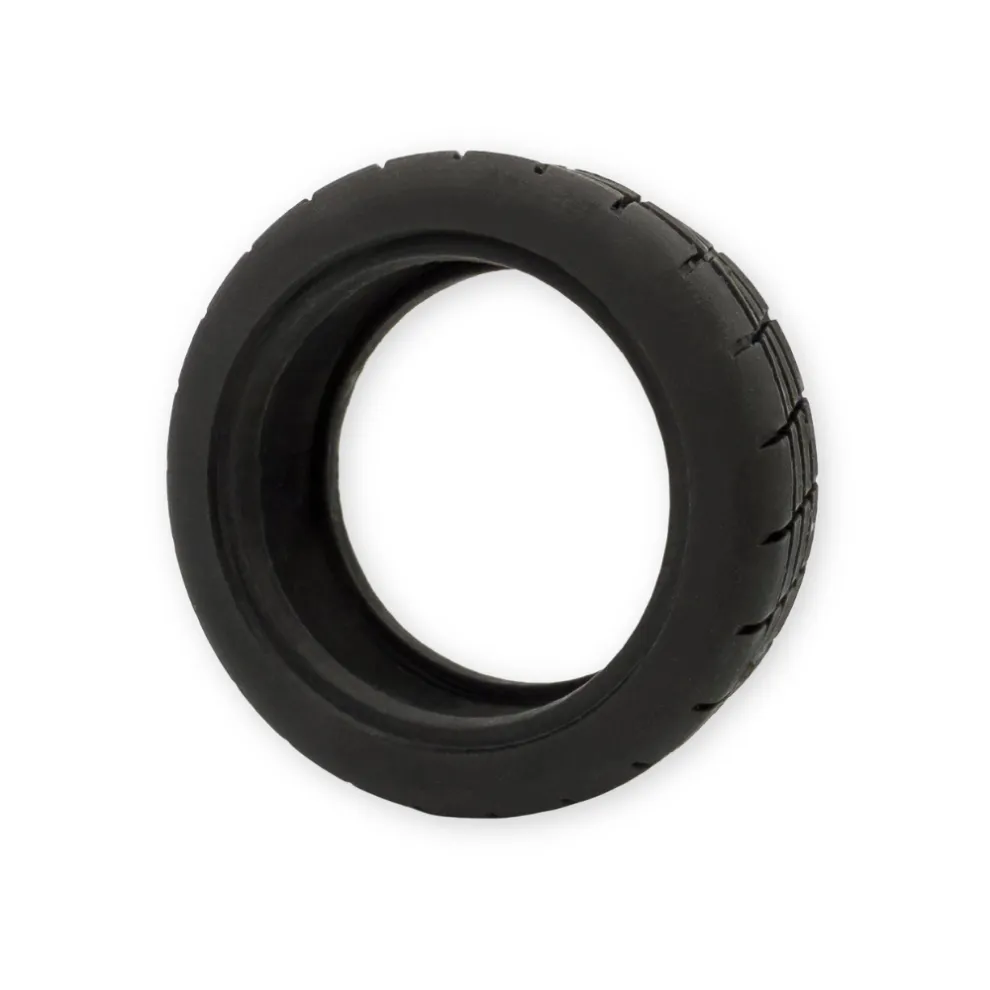
FLX-300 elastomer resin was developed for applications where parts must withstand compression without permanent deformation. Its Shore A 44 hardness provides comfortable compressibility, while the low compression set (1.7% at 25°C) ensures reliable shape recovery. Parts maintain both flexibility and surface hardness over extended periods, making this elastomer resin ideal for gaskets, dampers, soft robotics, and custom-fit components.
Mechanical properties
Tensile Stress at Break: 3.2 MPa (ISO 37, post-cured)
Elongation at Break: 232.3% (ISO 37, post-cured)
Modulus of Elasticity: 15.6 MPa (ISO 37, post-cured)
Tear Resistance: 6.4 kN/m (ASTM D624)
Compression Set (25°C, 72h): 1.7% (ASTM D395)
Compression Set (70°C, 72h): 3.5% (ASTM D395)
Vertical Rebound: 7% (ASTM D2632)
Viscosity: 2904 mPa·s (ISO 2555 at 25°C)
Hardness: 44 A (ASTM D2240)
Water Absorption (24h): 0.79% (ASTM D570)
Compatible UV Wavelength: 365 – 420 nmAccuracy
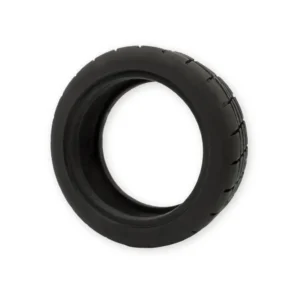
FLX-300 produces dimensionally accurate and stable elastomer prints. Shore A 44 softness and low compression set ensure that parts maintain their dimensions well after compression. This elastomer resin is suitable for custom gaskets, sealing components, vibration dampers, soft robotics, and other applications where compressible fit and shape recovery are important.
Printer Compatibility
FLX-300 is designed to work even on low-powered MSLA/LCD 3D printers equipped with LED light sources emitting 365-420nm UV light. Compatible with color and monochrome LCD 3D printers like Phrozen Sonic Mini 8K, Elegoo Saturn, or Anycubic M5.
It also works great on DLP 3D printers like Asiga, Elegoo Mars 4, or Anycubic Photon D2.
You can find recommended 3D printing settings for many 3D printers here: AmeraLabs resin settings.Surface
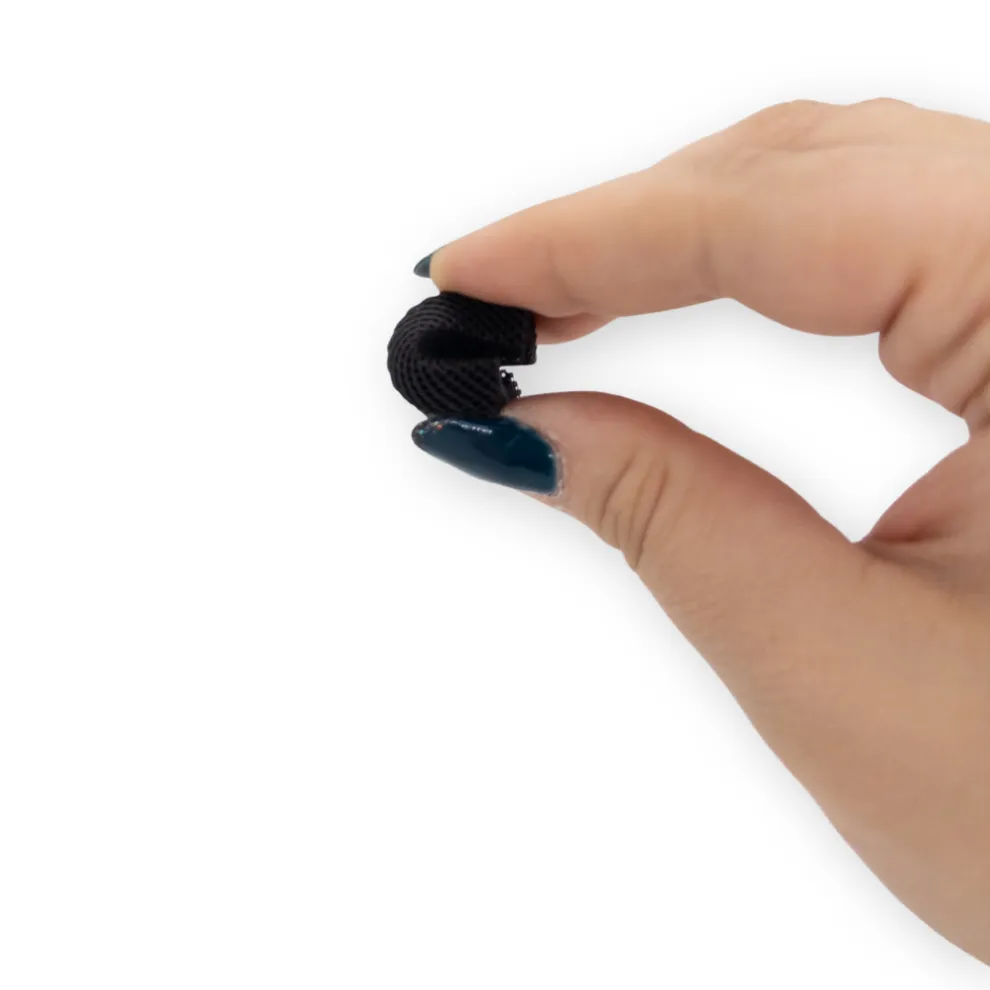
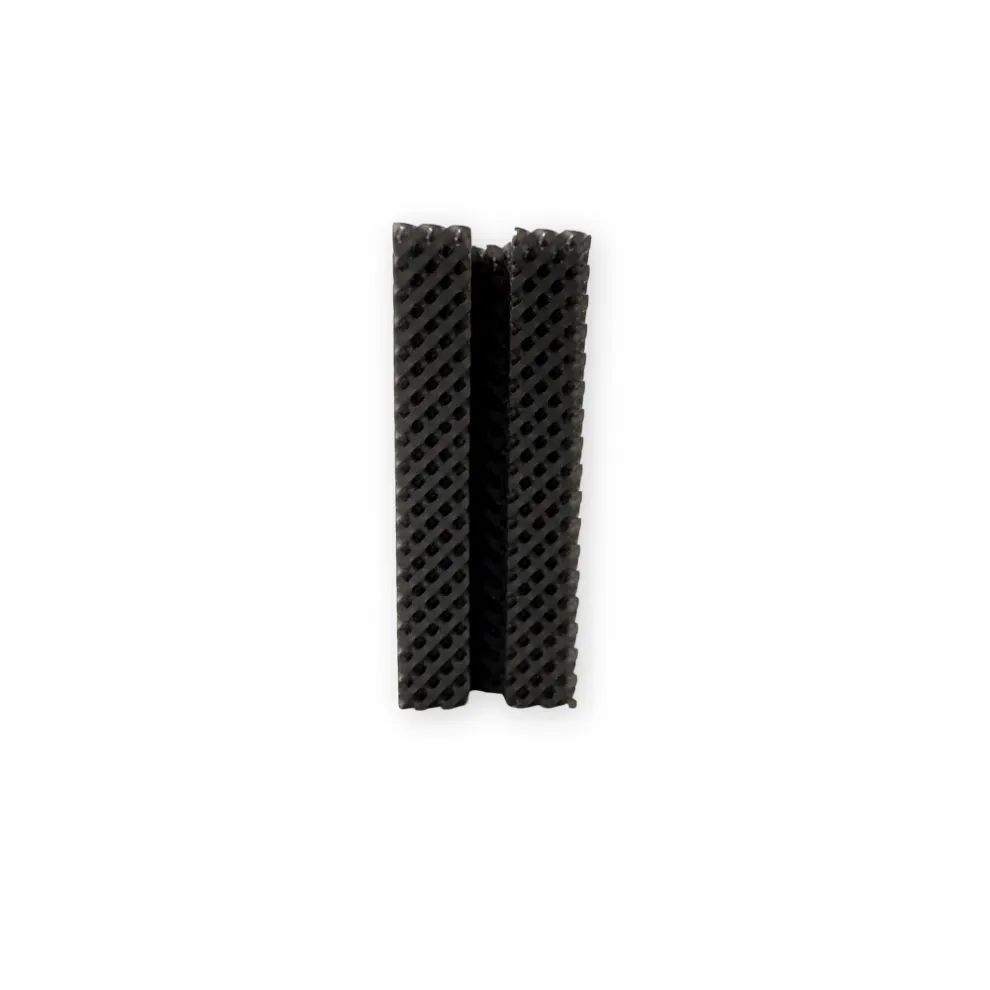
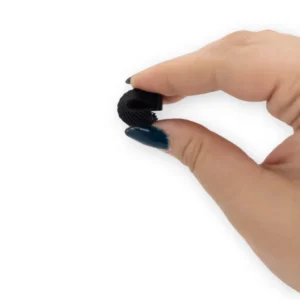
After post-cure, the print does not feel sticky or tacky and is pleasant to touch. The surface of the FLX-300 elastomer resin print is smooth with Shore A 44 hardness – soft and compressible like rubber.
Since this elastomer resin is flexible, printed parts can be trimmed or cut with a simple hobby knife.
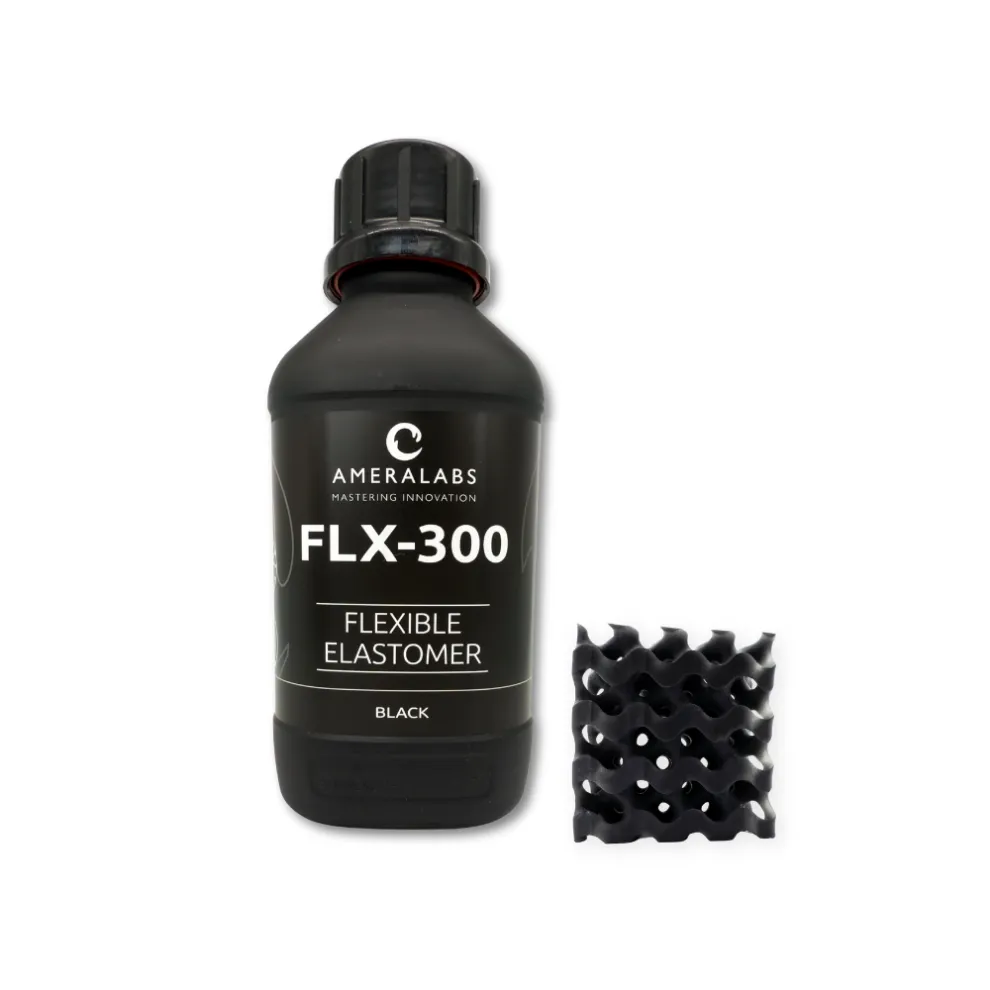
Resin is carefully pigmented and available in solid black color.Humidity and chemical resistance
FLX-300 has low water absorption of 0.79% over 24 hours (ASTM D570), making it suitable for sealing applications where parts come in contact with water. The material will not significantly deform or change its mechanical properties due to humidity or water exposure.
The material has not been tested for resistance to organic solvents or other chemicals. Test with your specific application substances if chemical contact is expected.Printing tips
For a successful print, we recommend:
- Heat the resin to at least 25°C before printing.
- Level your build plate.
- If it’s your first print with this resin, print something small first. We recommend this calibration model.
- Find initial printing settings here: AmeraLabs resin settings.
- Use support column thickness of 1.5-2 mm and support tip thickness of 0.4-0.5 mm.
- Keep the support spacing low, for example 2 mm.
- Avoid “tree” supports and increase cross-bracing between the columns.
- Use rafts with thickness corresponding to your bottom + transition layer height.
- Use slower lift speeds: 45 mm/min for bottom layers, 45-75 mm/min for normal layers.
- Use long wait times of 2-10 s before curing, especially for large or hollowed models and big printers.
- Important: FLX-300 should not be used with PDMS based resin trays. We strongly recommend using fluoropolymer films (FEP, PFA, ACF, etc.)
Let us know if you have any trouble. We are here to help: Facebook messenger, support@ameralabs.com
Cleaning procedure
FLX-300 material has a very high viscosity compared to most 3D printing resins. Supports should be removed before washing since they could obstruct the flow of IPA to the model. Important: Do not leave FLX-300 submerged in IPA or any other liquid for more than 30 minutes at a time. Doing so might affect the final properties of the polymer material.
If you use a Wash and Cure station, leave the printed object submerged in IPA for 15 minutes, then take it out to dry in the air. Depending on the geometry of the model, it might require repeated washing to remove resin from holes, negative features, and lattices. Washing and drying can be repeated as many times as needed for satisfactory results.
Soaking in IPA without agitation is not recommended for this high-viscosity elastomer resin.
If you prefer cleaning with an ultrasonic cleaner, we recommend putting a printed part into a container with IPA, closing it well, and putting the container into the ultrasonic cleaner filled with water for 5 minutes. Leave it for no more than 15 minutes. No additional heating is necessary.
After washing, parts should be left to dry for at least 30 minutes.Post-curing procedure
It is easier to remove supports before post-curing. However, you can also post-cure a print with supports and remove them later. Depending on the model, this can help to obtain better geometries if you have such a goal. Post-curing time depends on your curing station. It can vary from 15 minutes to 1 hour (until the surface of your 3D print becomes non-sticky). For better and faster curing, use vacuum or inert gases during curing to reduce oxygen inhibition. You should post-cure immediately after cleaning and drying. After proper post-curing, the surface of FLX-300 printed objects should be completely non-tacky while maintaining its soft, compressible properties.