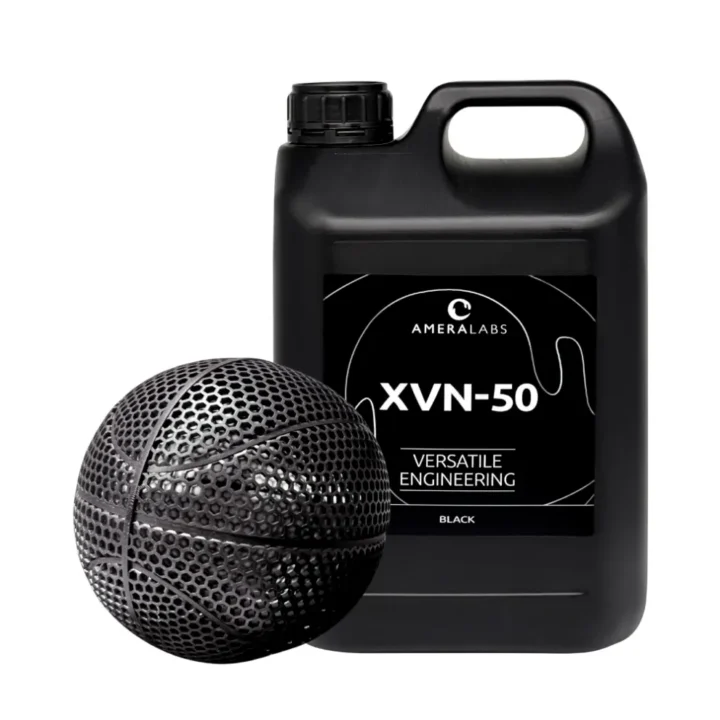
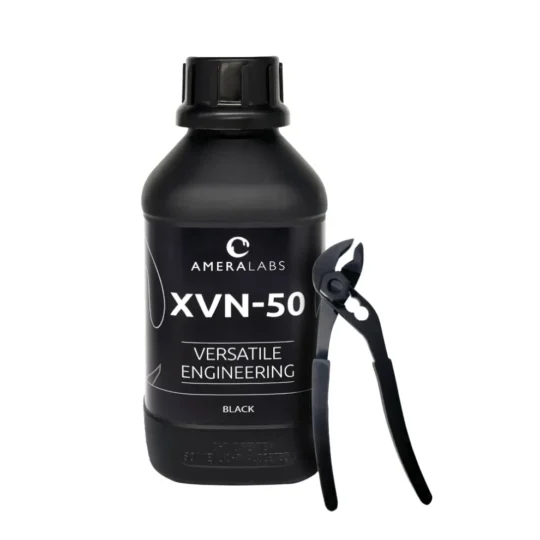
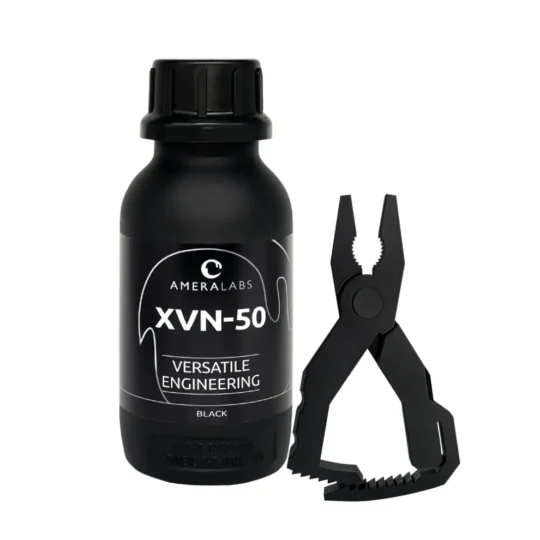
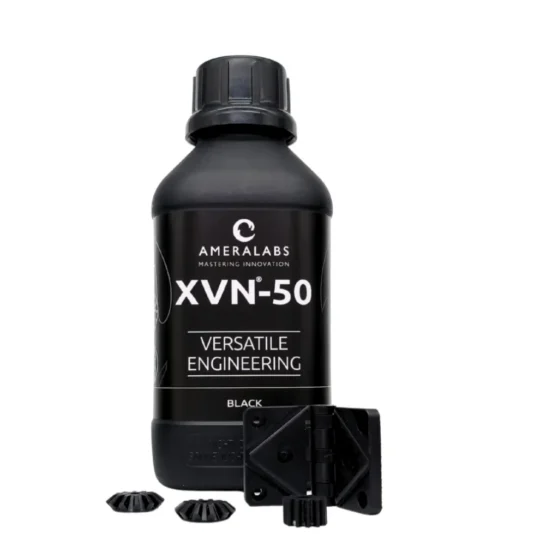
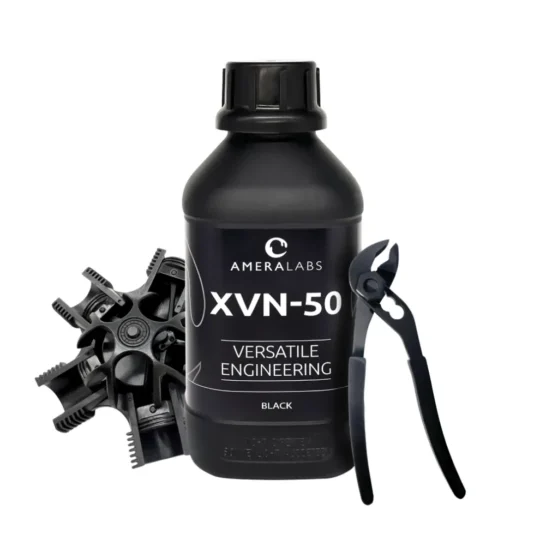
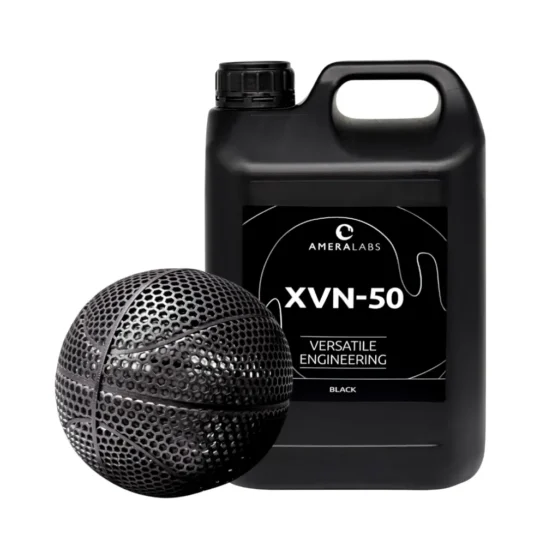
XVN-50
Best suited for
- Rapid Prototyping
- Functional Parts
From €44.00
Why XVN-50 is Your Best Choice for
Your Next Project
Tough and Flexible
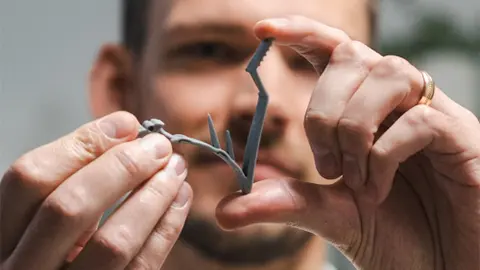
Say goodbye to fragile prints. XVN-50’s impact resistance and ability to handle high bending forces ensure your parts stay strong without sacrificing flexibility.
Spot-On Accuracy
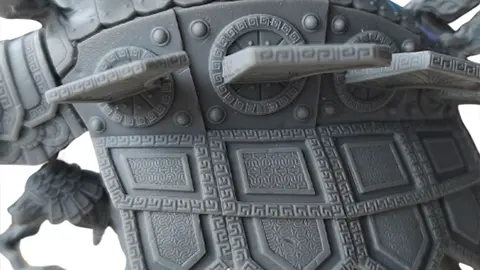
No more misaligned assemblies. With dimensional stability and precision, XVN-50 delivers prints that match your designs perfectly every time.
Easy Finishing
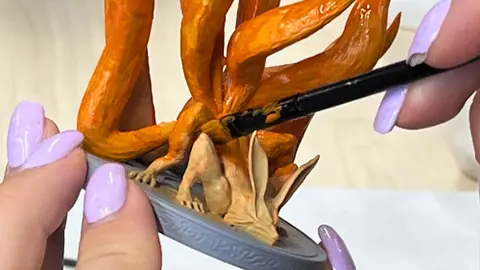
Hate sticky residues? XVN-50 cures to a hard, non-sticky surface that’s simple to sand, drill, or paint - making post-processing a breeze.
Frequently asked questions
The most versatile resin for mechanical parts
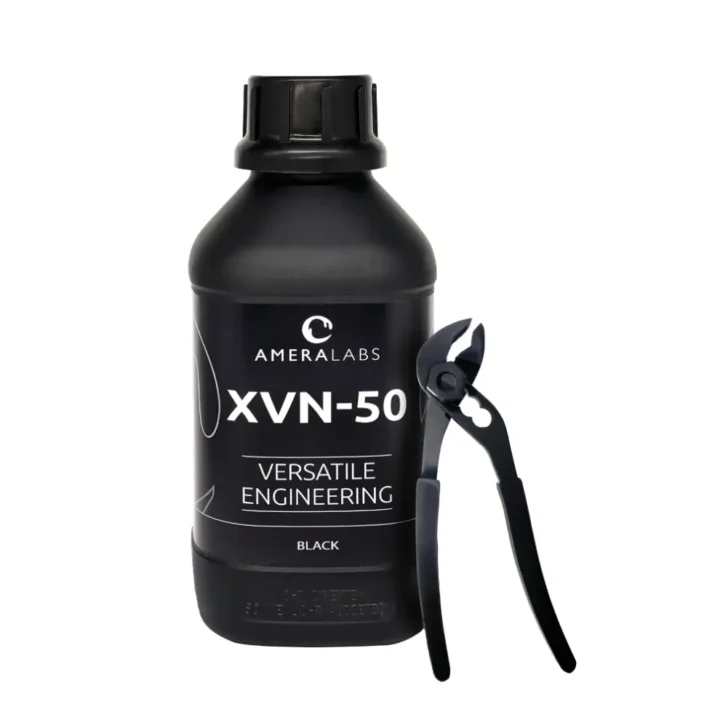
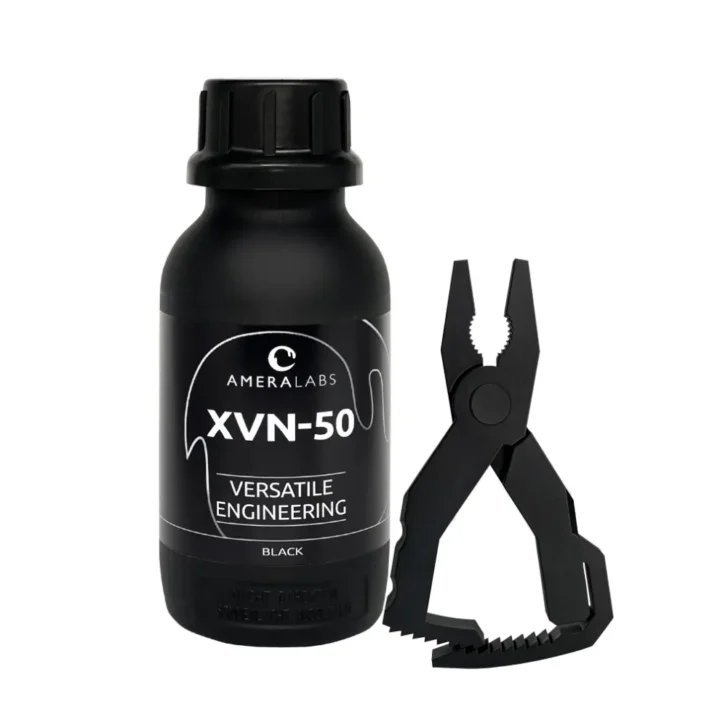
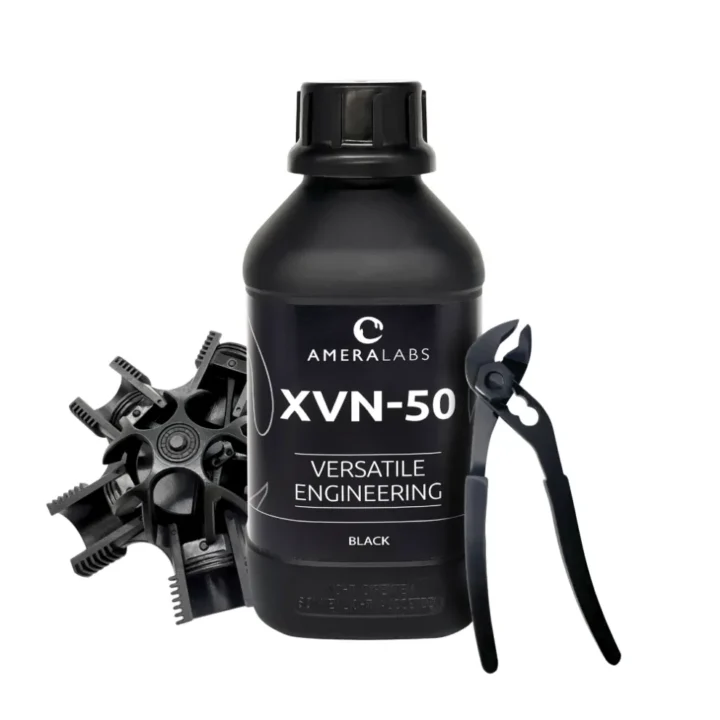
XVN-50 resin was developed to be the most versatile tool for any maker with a resin 3D printer. We call it an “adjustable wrench of resin 3D printing”. Its balanced flexibility, stiffness, impact resistance, and tensile strength make it an excellent choice for different applications.
We asked ourselves what resin we most often needed in our workshop and then focused on developing those properties.
Mechanical properties
Tensile Stress at Break: 37.5Â MPa (ISO-527, post-cured)
Tensile Strain at Break: 51.2 % (ISO-527, post-cured)ÂFlexural Modulus of Elasticity: 1.82 GPa (ISO-178, post-cured)
Flexural Stress at Yield: 62.3 MPa (ISO-178, post-cured)
Flexural Strain at Yield: 6.7 % (ISO-178, post-cured)Compression Modulus of Elasticity: 1.52 GPa (ASTM D695, post-cured)
Viscosity: 560 cPs (ISO 2555 at 25°C)Â
Hardness: 82Â D (ASTM D2240)Â
Compatible UV Wavelength: 365 – 420 nmAccuracy
XVN-50 produces dimensionally accurate and stable resin prints.
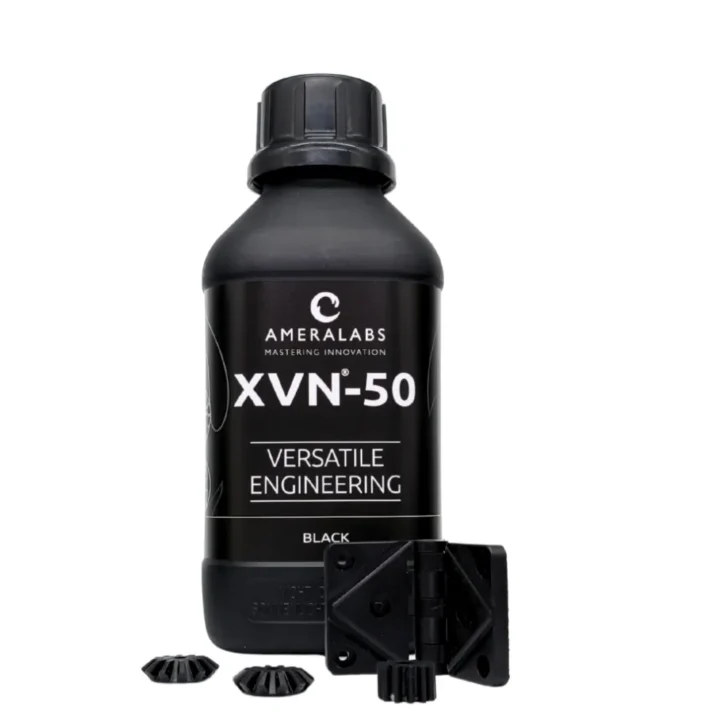
Stiffness and added flexibility ensure that the 3D prints are precise but not brittle. This rigid resin is perfect for prototypes, robotic parts, engineering applications, snap-fit parts, and other end-use products where assembly is required.
Printing speed
XVN-50 is designed to work even on low-powered MSLA/LCD 3D printers equipped with LED light sources emitting 365-420nm UV light. Compatible with color and monochrome LCD 3D printers like Phrozen Sonic Mini 8K, Elegoo Saturn, or Anycubic M5.
It also works great on DLP 3D printers like Asiga, Elegoo Mars 4, or Anycubic Photon D2.
You can find recommended 3D printing settings for many 3D printers here: AmeraLabs resin settings.
Surface
After post-cure, the print does not feel sticky or tacky and is pleasant to touch. The surface of the XVN-50 resin print is hard (82 shore D) and is not easy to scratch.
Since this resin is not brittle, it is easy to cut supports with a simple hobby knife. 3D printed models can be sanded, drilled, tapped to add threads, and painted.
Resin is carefully pigmented and available in a solid black color.
Humidity and chemical resistance
XVN-50 is relatively resistant to moisture. Water absorption is only 3.12% over 24 hours (ASTM D570). That means it will not deform or significantly change its mechanical properties due to air humidity or quick contact with liquids.
However, 3D printed objects with XVN-50 material should not be used for models and parts intended for long-term contact with water, organic solvents, or other liquids.
If you need resin resistant to humidity and chemicals, look at our AMD-3 resin.
Printing tips
For a successful print, we recommend:
- Level your build plate.
- If it’s your first print with this resin, print something small first. We recommend this calibration model.
- Find initial printing settings here: AmeraLabs resin settings.
- Use support column thickness of 1.5-2 mm and support tip thickness of 0.3-0.5 mm.
- Use attachment layer.
- Hollow your models.
- Use slower lift speeds. 5 mm/min for bottom layers, 40-60 mm/min for normal layers.
- Let us know if you have any trouble. We are here to help: Facebook messenger,  support@ameralabs.com
Cleaning procedure
XVN-50 material has a low-medium viscosity. When cleaning, pay attention to small gaps and holes in your model. Make sure there is no resin trapped in them.
If you use a Wash and Cure station, submerge the printed object in IPA for 15 minutes. Depending on the results, you can repeat this step and wash for 10 more minutes.
If you prefer cleaning with ordinary IPA baths, here is our easy 4 steps cleaning procedure:
After taking your printed object off the build plate, submerge it in the IPA bath for 10 minutes.
Swirl the IPA bath with the part in it actively for another 1 minute.
Leave it still but fully submerged for another 10 minutes after swirling. At this point, it would be wise to change IPA to a clean one.
Finally, swirl the bath actively again for 1 minute.Evaluate cleaning results and repeat this procedure only once (if needed).
If you prefer cleaning with an ultrasonic cleaner, we recommend putting a printed part into the container with IPA, closing it well, and putting the container into the ultrasonic cleaner filled with water for 10 minutes. Leave it for no more than 20 minutes. No additional heating is necessary. After washing the specimens, they should
Do not leave models submerged in IPA or any other liquid for more than 1 hour. Doing so might ruin your models and affect the final properties of the polymer material.
Post-curing procedure
It is easier to remove supports before post-curing. However, you can also post-cure a print with supports and remove them later. Depending on the model, this can help to obtain better geometries if you have such a goal. Post-curing time depends on your curing station. It can vary from 5 minutes to 1 hour (until the surface of your 3D print becomes non-sticky). You should post-cure immediately after cleaning and drying. After the proper post-curing surface of XVN-50 printed objects should be completely non-sticky and very hard to scratch.